Sep 28, 2026

Surefront brings several parts of the product process together, from product development and product information to supplier collaboration and commercial workflows.
But a fashion brand looking for an alternative may not need the same mix of capabilities.
Your team may want software that stays closer to styles, tech packs, samples, revisions, and approvals. Or the priority may be connecting development more closely with ERP, production, inventory, and other business operations.
That difference in focus is important when comparing product lifecycle management (PLM) software and broader fashion platforms.
This guide compares six Surefront alternatives based on what they cover, how they approach fashion product development, and where each platform may fit.
TL;DR
These are the top six Surefront alternatives for fashion teams to consider in 2026:
Centric PLM
WFX
Uphance
PTC FlexPLM
CGS BlueCherry
What Surefront Does
Surefront brings product development, product information, merchandising, and wholesale work into one platform. It helps internal teams, suppliers, and commercial users work with shared data and connected workflows instead of passing updates between separate tools.
Its capabilities cover several connected parts of the product and commercial workflow:
Product Development and Product Lifecycle Management
Surefront supports product teams from early development through revisions and approvals. Teams can develop products in a shared space where samples, tech packs, assortments, and other product details stay tied to the same record.
Its PLM tools also support team collaboration and workflow management, helping teams keep development tasks and handoffs organized.
Product Information Management
Its product information management tools give brands a central place to organize product details and catalogs.
Teams can manage a shared catalog library, create fashion line sheets, and use tags or custom fields to sort product information. This gives people working with the same products a consistent place to find current details.
Merchandising Operations
Surefront also supports merchandising work for retail buying teams. Buyers can manage categories, support merchandising planning, and collaborate with vendors through the platform.
Product information stays connected to those decisions, making it easier to review assortments and coordinate updates with suppliers.
Wholesale Operations
For wholesale operations, Surefront connects vendor communication with quotes, purchase orders, line sheets, and sales order management.
Teams can send quotes to retailers, work with suppliers, and track related sales activity within the platform. Its customer relationship management (CRM) tools support the commercial side of these product workflows.
Why Teams Compare Surefront Alternatives
Surefront covers a broad mix of product, merchandising, and commercial workflows, but that does not mean the same setup will fit every fashion brand. The reason to compare alternatives often comes down to the way your team works and which parts of the process need the most attention.
Common reasons include:
Performance and navigation – Some users have experienced slower performance during heavier usage and extra friction when searching for products. If those tasks are important to your team, test them with your own product data during a demo.
More fashion-specific PLM depth – A brand may prefer a platform centered more closely on styles, materials, tech packs, samples, revisions, and approvals.
Closer connections to business operations – Some teams may need product development to connect more directly with ERP, production, inventory, or supply-chain systems.
A different software scope – Surefront combines PLM, product information management (PIM), merchandising, and wholesale capabilities. Some brands may prefer a platform with a narrower product-development focus or one that extends further into operational management.
The important difference is where each platform puts its depth and how closely that scope matches your brand's workflow.
6 Surefront Alternatives Worth Considering
There are several platforms to consider if Surefront does not quite match the way your fashion team works. Below, you’ll find six alternatives with different approaches to product development, PLM, and broader business operations.
1. Onbrand PLM
Onbrand PLM is built specifically for fashion brands that want to move from early ideas into product development without losing track of the details. Designers, product developers, and production teams can keep the details behind each style connected as products move from early development toward production.
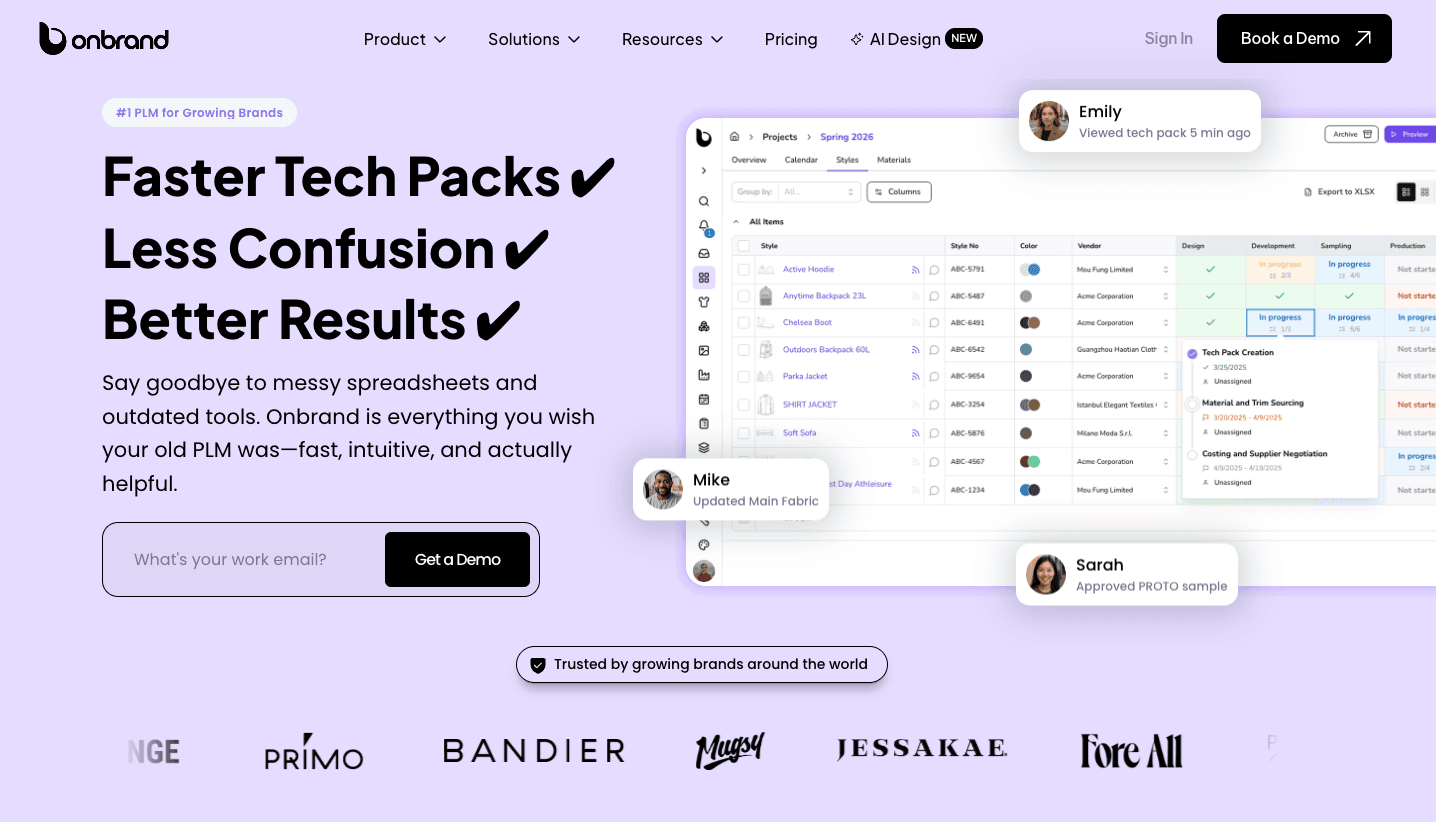
Teams can create tech packs up to 55% faster and shorten product development by up to 4 weeks. Onbrand also offers AI Design for generating and exploring concepts, reviewing visuals together, and moving approved design assets directly into PLM.
How It Differs From Surefront
Onbrand keeps fashion design and product development at the center of its PLM workflow. A style can move through development in the same workspace, so product details, supplier input, revisions, and approvals stay connected as the design develops.
Surefront covers a wider mix of PLM, PIM, CRM, merchandising, and wholesale workflows. Onbrand is more focused on the work fashion teams handle as they develop products and prepare them for production.
That focus also carries into setup. Brands can migrate to Onbrand in as little as 10 days, giving teams a practical path to bring existing product information into their new PLM.
Key Features
Build and update fashion tech packs in a shared workspace.
Manage collections, styles, colorways, materials, and product details.
Track samples, revisions, comments, and approvals.
Manage costing, supplier information, and development history.
Collaborate with internal teams and external suppliers.
Use Onbrand AI Design to generate concepts, explore variations, and move approved assets into PLM.
Things to Consider
Onbrand is intentionally centered on fashion design and product development. Brands that also need the broader CRM, PIM, merchandising, or wholesale functions available in Surefront can consider how those parts of their existing software stack would work alongside Onbrand.
Best For
Fashion brands that want design and product development at the center of their PLM workflow.
Considering a more fashion-focused alternative to Surefront? Explore Onbrand PLM today.
2. Centric PLM
Centric PLM is an enterprise PLM platform built for fashion, retail, footwear, consumer goods, and other product-led industries. It gives product teams one system to manage the lifecycle from early development through sourcing and commercialization.
Large brands can also connect product information with 2D and 3D design tools, suppliers, and visual collection planning.

Source: centricsoftware.com
How It Differs From Surefront
Centric puts more of its focus on the product lifecycle itself. Its scope follows products through development and commercialization, with added depth around sourcing, compliance, and complex product data.
Surefront combines PLM with PIM, CRM, merchandising, and wholesale functions. Centric stays more centered on enterprise product creation, development, sourcing, and commercialization.
Key Features
Manage product creation from concept through commercialization.
Connect 2D and 3D design tools with development work.
Build and manage bills of materials (BOMs), costing, and product data.
Coordinate sourcing, prototyping, testing, and certification.
Use visual tools to plan collections and support innovation.
Things to Consider
Centric can take time to learn and configure, especially for teams working through many libraries, views, and product data. Navigation may also take some getting used to.
Best For
Larger fashion, retail, and consumer-goods organizations that need extensive PLM coverage.
3. WFX
WFX is fashion-focused software built for apparel and related product businesses. Its fashion PLM follows products from early planning and design through development, sourcing, and production. A wider WFX suite also includes apparel ERP, MES, and other operational systems.

Source: worldfashionexchange.com
How It Differs From Surefront
WFX puts more emphasis on fashion-specific development workflows. Product specifications, sampling, costing, and vendor activity can stay connected as a style moves through development.
Surefront combines PLM with PIM, CRM, merchandising, and wholesale functions. WFX takes a different route, with fashion PLM alongside separate ERP and manufacturing products for companies that want development to connect further into operational work.
Key Features
Build version-controlled tech packs with BOMs and measurements.
Track samples, approvals, costing, and sourcing activity.
Give vendors access to shared product and RFQ information.
Manage product data through cloud-based fashion workflows.
Follow milestones and supplier updates in real time.
Things to Consider
WFX covers a broad range of fashion workflows, but PLM, ERP, and MES sit in different parts of its product suite. Brands should consider which products they actually need.
Best For
Fashion businesses that want fashion-specific PLM with options to connect development to broader operational systems.
4. Uphance
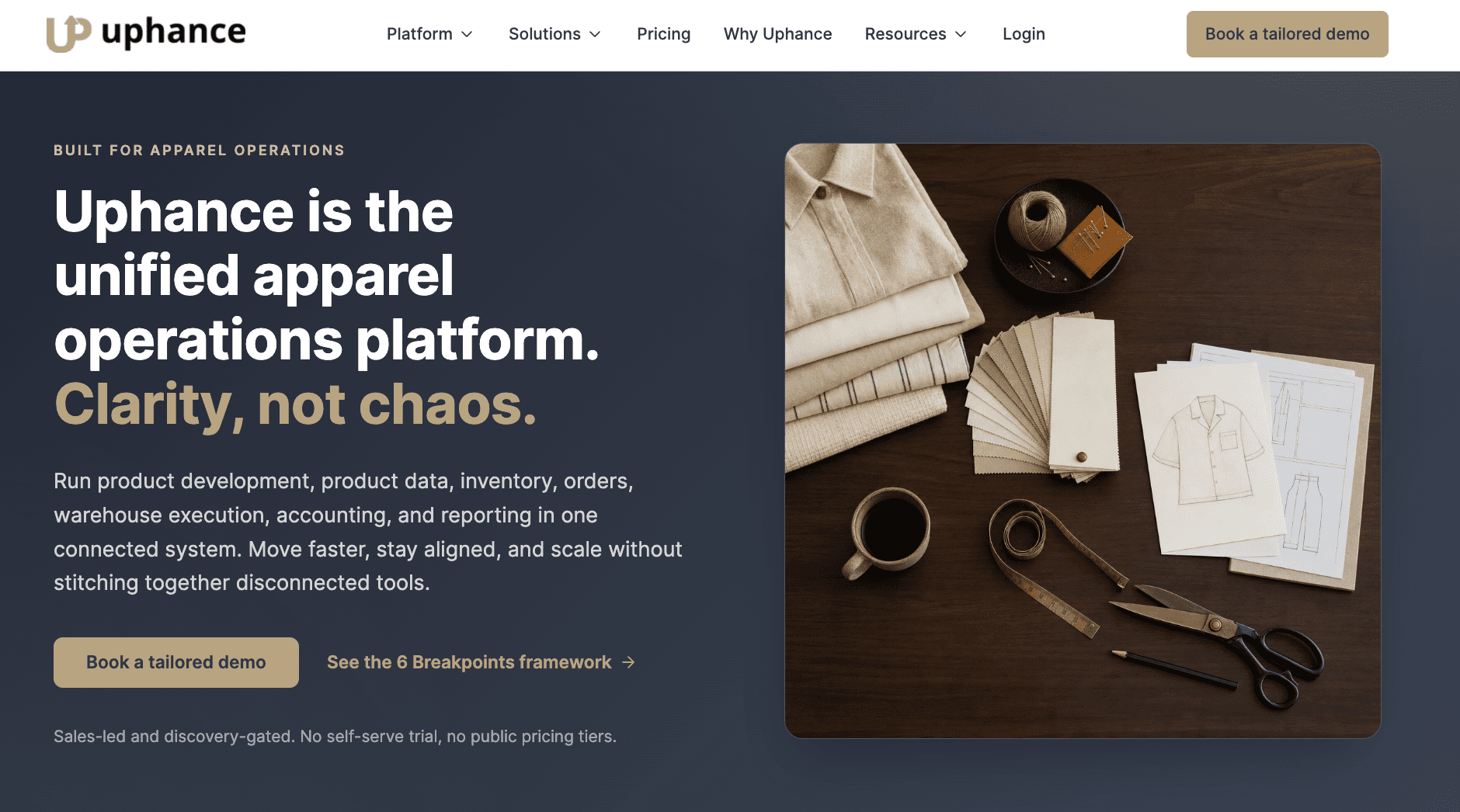
Uphance is apparel-focused software built to connect product development with day-to-day operations. Product information can continue into production, inventory, orders, and fulfillment, so teams can manage more of the business in one system.
The software is aimed at growing apparel brands, wholesalers, and manufacturers that want fewer disconnected tools and spreadsheets.
Source: uphance.com
How It Differs From Surefront
Uphance places more emphasis on operational management beyond development. That gives teams a closer connection between product development and the operational work that follows.
Surefront combines PLM, PIM, CRM, supplier collaboration, merchandising, and wholesale workflows. Uphance has a stronger apparel-operations angle, with product development connected more directly to inventory, warehouse, and order processes.
Key Features
Manage tech packs, BOMs, factory POs, and production records.
Track inventory by location and sales channel.
Handle wholesale and DTC orders in one system.
Support warehouse receiving, picking, packing, and fulfillment.
Keep customer and order data connected for internal teams.
Things to Consider
Uphance covers a wide part of the apparel business, so brands should check which existing tools it would replace and which integrations they still need.
Best For
Growing apparel brands that want product development connected with inventory, orders, production, fulfillment, and other business operations.
5. PTC FlexPLM
PTC FlexPLM is an enterprise PLM solution for retail, fashion, footwear, apparel, and consumer-product industries.
It is built to manage product development from design and specifications through sourcing, costing, and supply-chain work. The software is positioned for larger organizations that need to manage complex product data at scale.

Source: ptc.com
How It Differs From Surefront
FlexPLM stays closely focused on enterprise product development and retail PLM. Its scope goes deeper into enterprise product development, with support for sourcing, compliance, complex product specifications, and product data management.
Surefront combines PLM with PIM, CRM, merchandising, and wholesale workflows. FlexPLM takes a different approach, with more emphasis on managing the product lifecycle from planning to market and supporting complex product structures for a large company or retail organization.
Key Features
Manage design, specifications, sourcing, and costing.
Organize complex product data and specifications.
Track sustainability and compliance information.
Coordinate product and supplier information through development.
Support enterprise-scale product development and supply-chain users.
Things to Consider
FlexPLM is built for enterprise use, so implementation and setup may require more time and internal coordination. Navigation can also take some getting used to.
Best For
Large fashion, footwear, retail, and consumer-product organizations managing complex product development.
6. CGS BlueCherry
BlueCherry is fashion and consumer-goods software built around the supply chain from concept through delivery.
PLM sits within a wider suite that extends product development into areas such as sourcing, production, inventory, and other business operations. It serves apparel, footwear, accessories, home goods, and other lifestyle-product businesses.

Source: bluecherry.com
How It Differs From Surefront
BlueCherry puts more emphasis on the wider fashion supply chain. Different parts of the BlueCherry suite carry product information beyond development and further into supply-chain and operational work.
Surefront combines PLM with PIM, CRM, merchandising, supplier collaboration, and wholesale workflows. BlueCherry takes a broader operational direction, which may appeal to companies comparing competitors with more extensive supply-chain coverage beyond product development.
Key Features
Manage product development through BlueCherry PLM.
Connect sourcing and procurement with downstream work.
Support manufacturing and shop-floor processes through MES tools.
Manage inventory, logistics, and warehouse activity.
Add ERP, wholesale, planning, and quality solutions as needed.
Things to Consider
BlueCherry offers a wide variety of modules, so buyers should decide which ones fit their existing systems. Its industry experts and implementation services may also be relevant when evaluating rollout effort and expected ROI.
Best For
Apparel, footwear, and consumer-goods businesses that want PLM connected with broader supply-chain and operational systems.
How to Choose the Right Surefront Alternative
Choosing an alternative starts with understanding what you want to change about your current workflow. Look at where your team spends extra time, which tools need to stay, and how far the new software needs to support the business.
Here are a few practical ways to narrow your options.
Identify the Workflow You Want to Improve
Start with the reason your team is looking for another option. You may want a workflow built more closely around fashion development, easier supplier collaboration, or a system that connects development with production or ERP.
For example, if sample comments are scattered between email and spreadsheets, look at how each option handles revisions, supplier feedback, and approvals. A specific problem gives you something practical to compare.
Decide What the New System Needs to Cover
List the work you actually want to manage in the new system. A design and product team may need styles, materials, tech packs, samples, costing, and approvals. An operations team may also need sourcing, production, inventory, or ERP functions.
Use that list to separate required capabilities from features you are unlikely to use. It also helps prevent a larger feature set from automatically looking like a better fit.
Check How Each Option Fits Your Existing Systems
Map out the software your team already relies on before choosing a replacement. That could include ERP, inventory, e-commerce, accounting, or design tools that need to exchange product information.
If you plan to keep your existing ERP, check how product data moves from development into that system. If you want to replace several tools, look at which functions the alternative can realistically take over.
Test the Workflow With a Real Style
Take one actual style from your collection and use it during demos or trials. Follow the same steps your team normally handles, such as creating the style, updating materials, revising a tech pack, adding supplier feedback, approving a sample, and handing the product off.
Pay attention to how many steps each task takes and where information lives. Testing real work can tell you more about how Surefront compares with each alternative than feature lists alone.
Looking for a More Fashion-Focused Surefront Alternative? Try Onbrand

Choosing between Surefront alternatives comes down to how closely the software fits the work your team needs to manage. Some options extend further into ERP and business operations, whereas others put more attention on the product development process itself.
For fashion brands that want the latter, Onbrand PLM keeps design and development connected as products move toward production.
Teams can work from the same product information, coordinate with suppliers, and keep decisions moving without adding unnecessary complexity to the process.
FAQs about Surefront alternatives
Is Surefront built specifically for fashion brands?
Surefront supports product development, merchandising, supplier collaboration, and wholesale workflows that fashion teams can use, but it is not limited to fashion. Brands comparing alternatives should look at how closely each system fits the way their teams develop and manage products.
Can you migrate product data from Surefront to another PLM?
Yes, product data can generally be moved to another PLM, but the migration process depends on the systems involved and the data you need to transfer. Before switching, review your product records, files, and other digital assets to decide what needs to move and how the new system will become your source of truth.
Do you need a PIM if you switch from Surefront to a PLM?
It depends on how your brand manages product information after development. PLM typically focuses on creating and developing products, whereas fashion PIM prepares and organizes product information for sales and other downstream uses. A DAM may also be used separately when a brand needs dedicated management for images and other digital assets.
Can a fashion brand use a PLM alongside its existing ERP?
Yes. Fashion brands can use PLM for product development and keep ERP for areas such as purchasing, inventory, finance, and other operational work. Before choosing an alternative, read its integration documentation and check how product data will move between the two systems.
Does industry focus matter when choosing a PLM?
Yes. Industry focus affects how closely a PLM fits the way your team develops products. Arena PLM is primarily geared toward engineering and manufacturing, whereas Onbrand PLM is built for fashion teams working with styles, tech packs, samples, suppliers, and approvals.