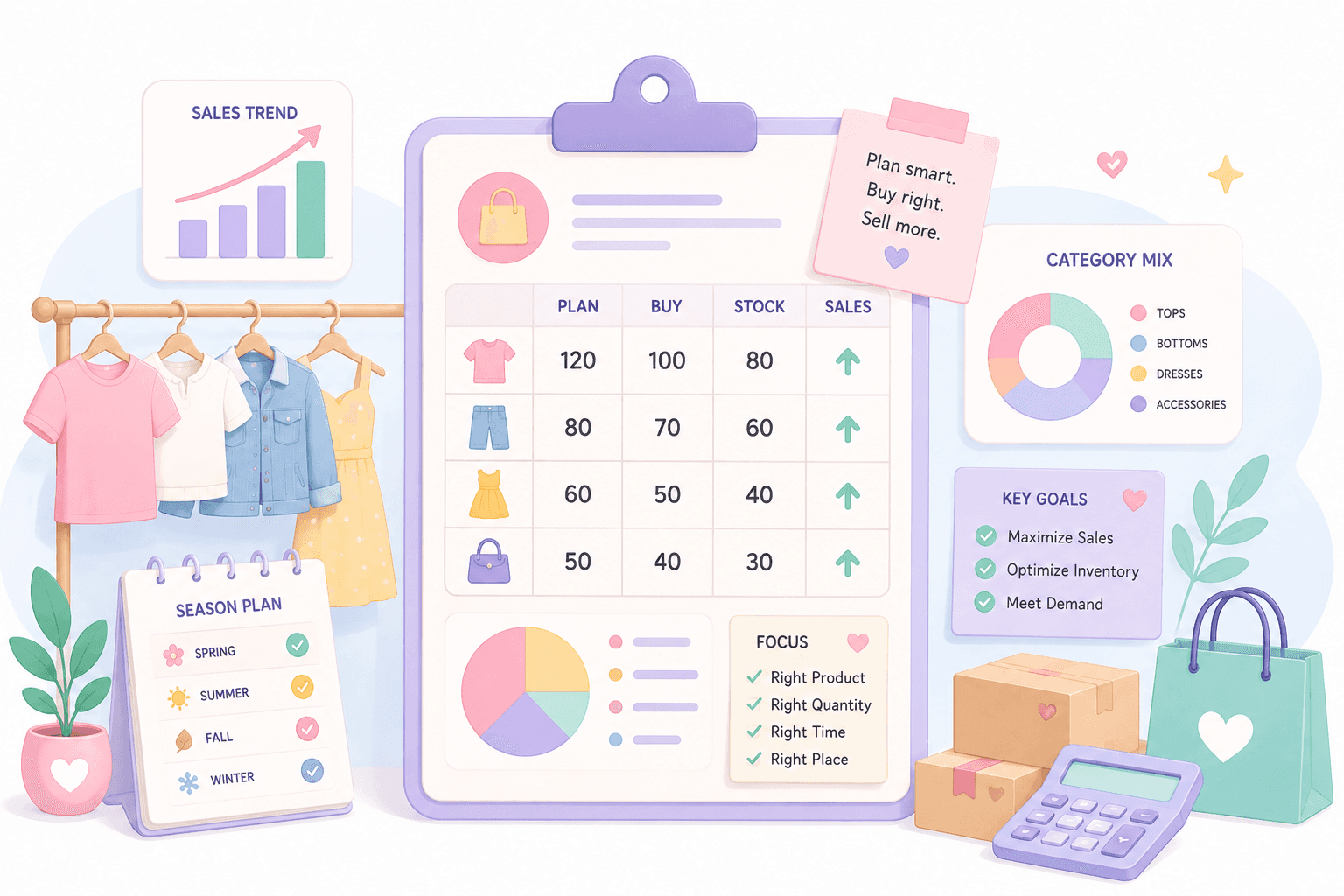
Planning a season is rarely just about picking products.
Merchandising teams have to decide how much to buy, where the budget should go, how deep an assortment should be, and what needs to change once sales start coming in. Those decisions get harder as categories, channels, and inventory grow.
Merchandising planning software helps bring that work into a more structured process. It sits within the broader category of retail planning software but focuses more closely on merchandise budgets, assortments, buying, and inventory decisions.
This guide compares seven merchandising planning software platforms, the planning work each one supports, and the retail or fashion teams they fit best.
TL;DR
These are the seven best merchandising planning software platforms in 2026:
Centric Planning
Toolio
RELEX Solutions
Oracle Retail Merchandise Financial Planning
Anaplan
Blue Yonder
Retalon
If you need software for the fashion product work behind those plans, Onbrand connects AI-powered design with PLM for product development.
What Merchandising Teams Actually Need From Planning Software
Merchandising teams need to connect financial targets with decisions about what to buy, how much inventory to carry, and where that inventory should go.
Merchandise financial planning sets expectations for sales, margin, inventory, and budgets, giving teams a financial framework for the season. Open-to-buy helps track how much of that budget remains available for additional purchases as plans change.
Assortment planning brings the focus to the product mix, including how broad or deep the assortment strategy should be by category, style, or SKU. Historical sales and current sales data give planners a starting point for demand forecasting and future inventory investment.
Further into the planning process, inventory allocation and localization determine where products should go based on stores, channels, or markets. Inventory visibility can help teams spot where stock is building up before it becomes excess inventory.
Teams can then follow sell-through and other key performance indicators as results come in. Better stock decisions can also contribute to fewer lost sales and higher customer satisfaction when products are available where demand exists.
The merchandise planning process spans pre-season planning and in-season adjustments. The seven platforms below vary in their depth of financial planning, assortment, allocation, forecasting, and connected enterprise planning.
Top 7 Merchandising Planning Software Platforms in 2026
A platform that works well for a large retailer may offer more planning depth than a smaller merchandising team needs. The important differences show up in the parts of the planning process each system is built to handle.
Here are seven merchandising planning platforms to consider in 2026, along with the key capabilities that set each one apart.
1. Centric Planning

Source: centricsoftware.com
Centric Planning is part of Centric Software’s retail planning and pricing suite.
It connects merchandise financial planning with assortment strategy, pricing, and inventory decisions, with tools designed to support planners from higher-level seasonal plans down to more detailed product and assortment decisions.
Its planning approach is especially relevant to fashion, apparel, footwear, and other product-driven retail categories where assortments, pricing, and inventory need to be reviewed throughout the season.
Centric also uses AI-supported demand signals and market data to help teams plan assortments and respond to changing market trends.
Key Features
Connects merchandise financial planning with assortment and trading decisions.
Uses demand forecasting to guide assortment depth, mix, and localization.
Supports pricing decisions throughout different product lifecycles.
Helps planners review seasonal performance, budgets, and inventory needs.
Supports assortment planning at a more detailed product level than spreadsheet-based planning.
Best For
Centric Planning works well for fashion and consumer product businesses that need financial, assortment, pricing, and inventory planning in one environment. It is particularly relevant for teams managing large assortments, multiple markets, or more complex product strategies.
2. Toolio

Source: toolio.com
Toolio brings merchandise planning, open-to-buy, assortment planning, and allocation into one retail planning solution.
It is designed to help merchants, planners, and finance work from the same plan, with forecasting and scenario planning built into the process.
Toolio also connects ERP, POS, ecommerce, and data warehouse sources into a shared planning environment.
That can support more data-driven decisions and reduce version control issues when several teams are working from changing plans.
Key Features
Supports merchandise planning and open-to-buy from initial budgets through in-season execution.
Helps retailers plan assortments at category, style, and SKU levels.
Uses AI-driven demand forecasting to account for promotions, stockouts, holidays, and other anomalies.
Includes scenario analysis for testing changes before they are applied to the active plan.
Connects merchandising, ERP, POS, and ecommerce data in a shared planning environment with real-time updates.
Best For
Toolio is a good fit for growing or multi-category retailers that want merchandise, assortment, and allocation planning in one system. It can also help planners, merchants, and finance work from the same planning data.
3. RELEX Solutions

Source: relexsolutions.com
RELEX Solutions combines merchandise financial planning, open-to-buy, assortment planning, demand planning, inventory planning, and replenishment within a broader retail and supply chain planning system.
Its approach is built around connecting customer demand with inventory, pricing, promotions, and merchandising decisions in one planning model.
RELEX also uses machine learning and AI-driven forecasting to support forecasting demand at a more detailed level.
That makes it relevant for retailers that need merchandising decisions to stay connected with inventory optimization and downstream execution.
Key Features
Supports merchandise financial planning and open-to-buy alongside assortment planning.
Uses machine learning for demand planning and forecasting demand as conditions change.
Connects inventory optimization with replenishment, allocation, and merchandising decisions.
Includes predictive and probabilistic forecasting capabilities for building more accurate demand forecasts.
Supports planning around promotions, pricing, inventory, and real demand signals.
Best For
RELEX is particularly relevant for retailers that want merchandising planning closely connected with demand, inventory, and replenishment. This can help teams optimize inventory and respond to demand, supporting better product availability and improved customer satisfaction.
4. Oracle Retail Merchandise Financial Planning

Source: oracle.com
Oracle Retail Merchandise Financial Planning supports strategic and financial merchandise planning at enterprise scale.
It helps retailers generate plans for sales, margin, receipts, inventory, and open-to-buy, with pre-season and in-season workflows that connect higher-level targets with merchandise and location plans.
Oracle also supports scenario-based planning, integrated forecasting, and reconciliation between planning roles.
Its planning capabilities can help larger retail teams coordinate financial targets with merchandise plans at different levels of the business.
Key Features
Supports pre-season and in-season financial planning with sales, margin, inventory, receipts, and open-to-buy metrics.
Connects merchandise and location plans with wider business objectives and approval workflows.
Includes integrated forecasting using sales history, weekly actuals, and unconstrained forecasts.
Supports scenario planning for comparing different financial and inventory strategies.
Provides omnichannel planning by selling channel, geography, and location.
Best For
Oracle Retail Merchandise Financial Planning is designed for large retailers managing financial and operational planning for multiple locations, channels, currencies, or regions. Its structured approach also suits retail organizations with complex planning hierarchies and formal approval processes.
5. Anaplan

Source: anaplan.com
Anaplan offers a purpose-built Merchandise Financial Planning application for retailers.
It connects merchandise strategies and financial targets through unified planning, giving merchandising, finance, and other teams a shared environment for forecasting, inventory planning, and reviewing the impact of changes.
Predictive forecasting and scenario analysis help teams test different assumptions as demand or business conditions change.
Anaplan’s broader connected planning approach also makes it relevant for organizations looking to reduce organizational silos between merchandising and other planning functions.
Key Features
Supports merchandise financial planning with prebuilt retail planning workflows.
Uses predictive analytics and AI-driven forecasts to inform inventory and merchandise plans.
Provides scenario modeling for comparing possible changes and their financial impact.
Supports real-time collaboration between merchandising, finance, and other planning teams.
Connects inventory plans with forecasts, assortment strategies, and financial objectives.
Best For
Anaplan makes sense for retailers that want merchandise financial planning connected with wider enterprise planning. Teams that need shared planning data and actionable insights between merchandising, finance, and other business functions may find it especially relevant.
6. Blue Yonder
Source: blueyonder.com
Blue Yonder supports merchandising through retail planning, merchandise operations, pricing, inventory, and supply chain planning.
Its merchandising tools are built around connecting item, vendor, cost, pricing, and inventory data so planners can work from a more consistent operating picture.
For retailers dealing with complex supply chains and frequent market shifts, Blue Yonder also brings advanced analytics, AI, and real-time data into planning and execution.
That makes it useful when consumer preferences shift quickly, and merchandising decisions need to stay connected with inventory and supply chain activity.
Key Features
Supports retail planning and category management for assortment, pricing, promotions, and product placement.
Connects item, vendor, cost, pricing, and inventory data through a shared merchandise operations foundation.
Uses real-time inventory and margin data to support pricing and buying decisions.
Links retail planning with broader supply chain planning and execution.
Applies AI and analytics to demand sensing, inventory decisions, and operational recommendations.
Best For
Blue Yonder fits larger retailers with complex merchandising, inventory, and supply chain needs. Its broader retail and supply chain capabilities are particularly relevant for organizations that want planning closely connected with operational execution.
7. Retalon

Source: retalon.com
Retalon combines merchandise planning with demand forecasting, assortment, inventory, and purchasing decisions.
Merchandisers can build detailed plans from higher-level targets, with changes at the store, department, or purchase level reflected back in merchandise and financial plans.
Its approach uses AI-powered demand forecasts to account for demand at the SKU level. Sales, pricing, inventory, purchase order, and shipping data can also feed into the planning process, giving teams a more detailed view when managing assortment complexity.
Key Features
Builds granular merchandise plans from higher-level financial targets.
Uses demand forecasting to support SKU-level merchandise decisions.
Supports assortment planning at different levels and product attributes.
Updates merchandise and financial plans as store, department, or purchase-level changes are made.
Connects sales, pricing, inventory, purchase order, and shipping data within the planning process.
Best For
Retalon is suited to retailers looking for integrated AI-driven retail planning with detailed merchandise and demand planning. It fits teams managing large assortments that need planning decisions informed by sales forecasting, historical performance, and changing demand.
Merchandising Planning Depends on Product Data Before the Buy
Merchandising decisions may happen closer to buying, but some of the information behind those decisions is created much earlier.
For fashion teams, products begin as styles and colorways that move through design, costing, sampling, revisions, and approval.
Along the way, teams establish materials, product costs, collection structure, development status, delivery timing, and other approved product details.
Merchandisers need access to that information as they plan which products will make up the season and prepare for buying decisions.
Product lifecycle management (PLM) is one system used to organize this product-development information as collections take shape and merchandising and buying decisions develop.
Keeping those records structured can also reduce the manual data entry involved when product information moves between teams and systems.
The connection is especially important in fashion because product lifecycles do not begin with a finished SKU. Merchandising teams are planning around products shaped by a series of development decisions.
Connecting merchandising with reliable upstream product data gives planners a more accurate foundation for the products they are preparing to buy and sell.
How Onbrand Supports the Product Work Behind Merchandising Plans
Onbrand gives fashion teams one connected workspace for moving products from early design concepts through structured product development.
Its two offerings, Onbrand AI Design and Onbrand PLM, support the creative and development work that gives merchandising and buying teams more structured product information as collections move toward launch.
Explore and Plan Collections With Onbrand AI Design
Onbrand AI Design gives design and merchandising teams a visual space to develop ideas before committing them to product development.
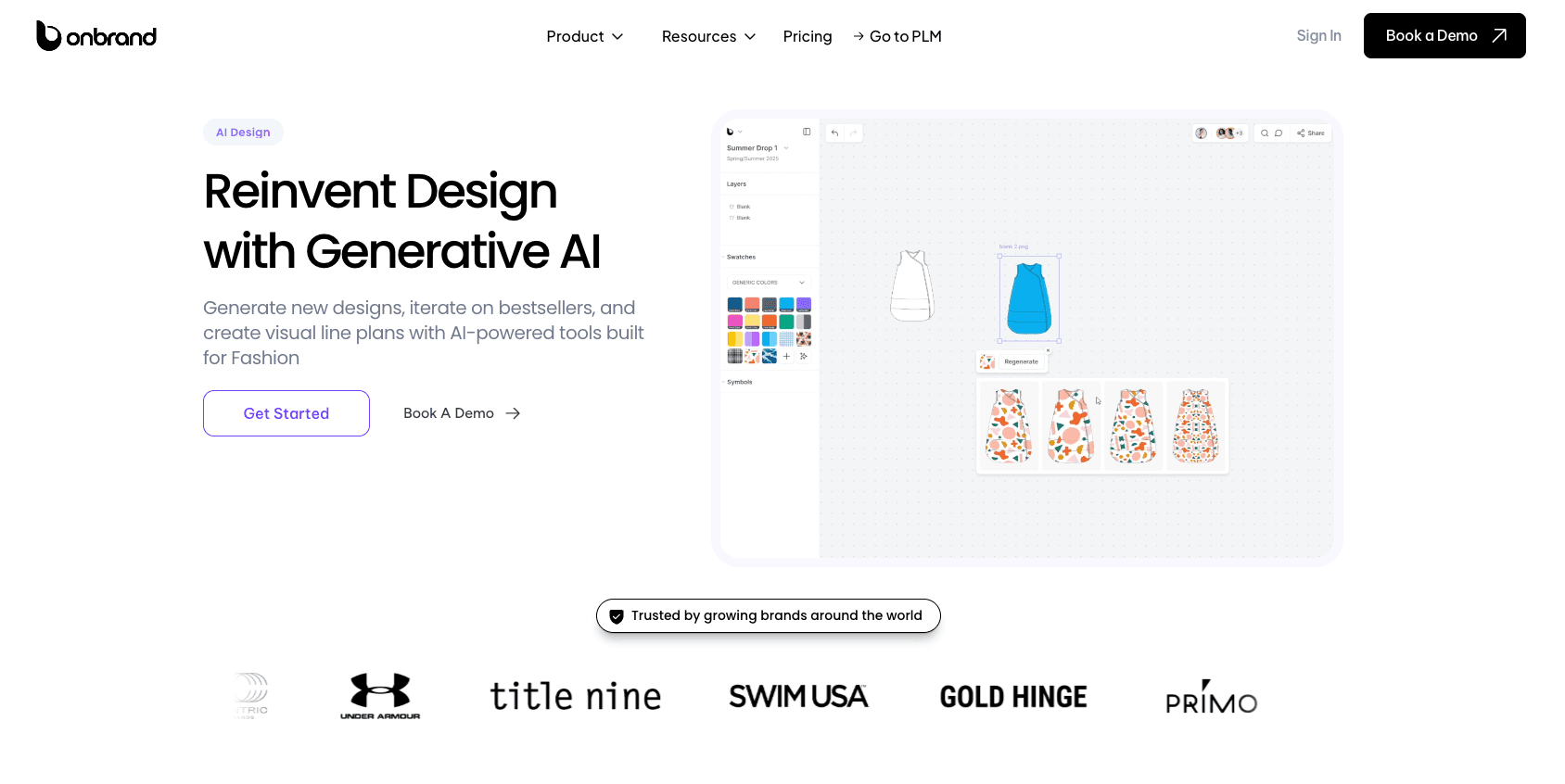
Teams can start with a text prompt, sketch, or reference image, then generate concepts and explore different silhouettes, colorways, trims, cuts, and product variations.
Fashion designers can turn sketches into mockups or on-model visuals, organize ideas on mood boards, and build visual line plans with the wider team. Shared boards, contextual comments, and version history keep feedback connected to the designs being reviewed.
Teams using Onbrand AI Design can achieve 10x faster design turnaround, create 30–50% fewer physical samples, and save 10+ weeks each year.
That gives brands more room to explore a collection visually before selected concepts move forward.
Move Approved Products Forward With Onbrand PLM
Onbrand PLM carries selected concepts into product development. Styles, colorways, materials, artwork, specifications, and other product details live in structured records that can be updated as a collection develops.
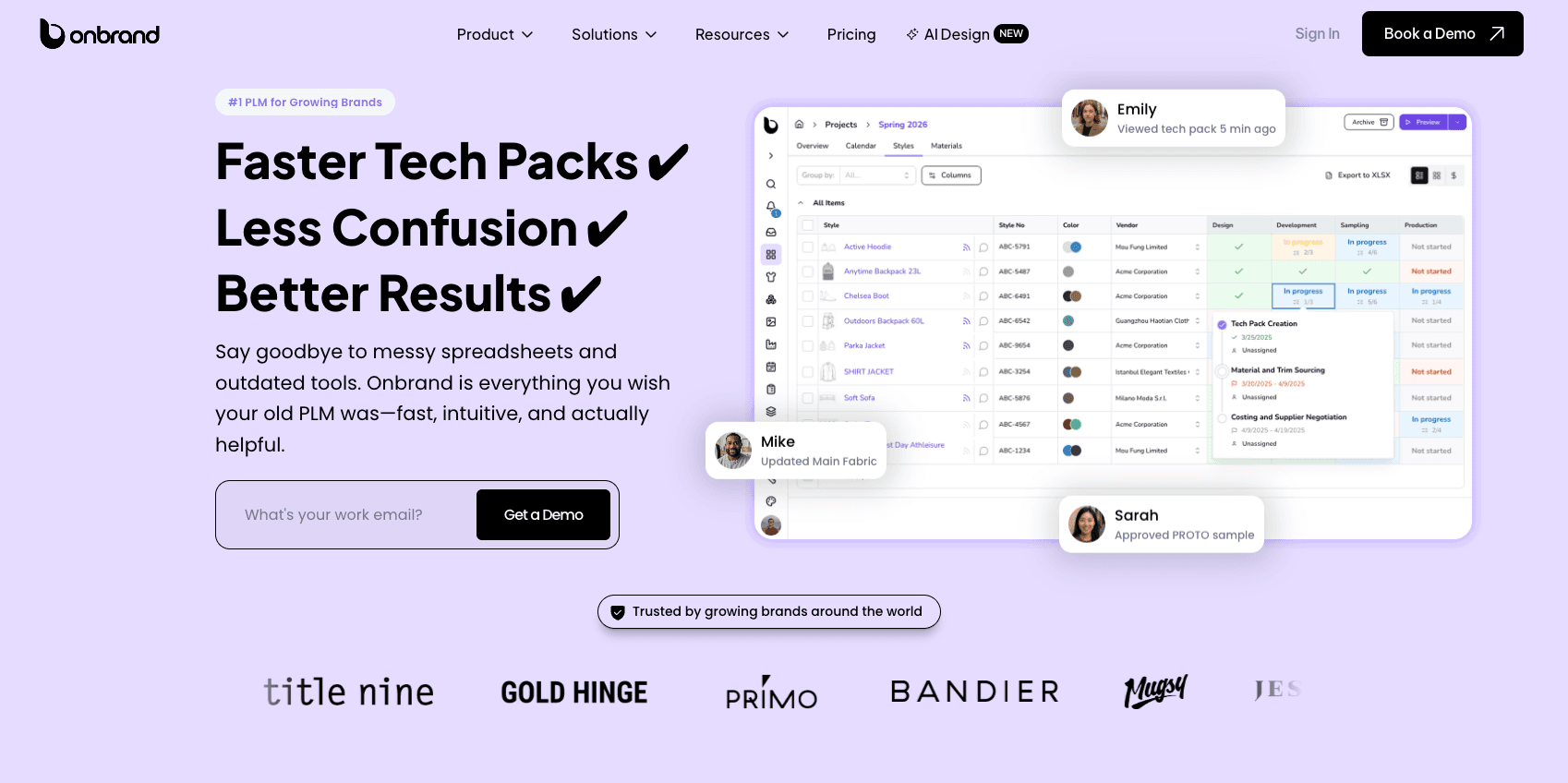
Tech packs, samples, revisions, approvals, and development timelines can all be managed in the same system. Collection planning keeps upcoming styles organized, and web-based tech packs give internal teams and vendors access to current product information as changes are made.
Because AI Design connects directly with Onbrand PLM, concepts, visuals, and product details can move into development without rebuilding the information elsewhere.
Brands can create tech packs 55% faster, reduce product development time by four weeks, and complete data migration and implementation in an average of 10 days.
Keeping design decisions, product details, and development progress connected gives fashion teams a more organized product foundation as collections move toward merchandising, buying, and launch.
Give Merchandising Plans a Better Starting Point With Onbrand

The best merchandising planning software depends on the decisions your team needs to manage, from financial planning and assortment to allocation, inventory, and broader enterprise planning.
For fashion brands, those plans work best when the product information behind them is already organized and current. Onbrand keeps design and product development connected before collections move into merchandising and buying.
Book a demo to see how Onbrand can support your fashion product development process.
FAQs About Merchandising Planning Software
What are the five Rs of merchandising?
The five Rs of merchandising are the right product, right place, right time, right quantity, and right price. Retailers use these principles to match products with consumer demand, maintain availability, and make better buying and inventory decisions.
What are the best merchandising apps?
For merchandise planning, software options include Centric Planning, Toolio, RELEX, Oracle Retail, Anaplan, Blue Yonder, and Retalon. They support different combinations of financial planning, assortment planning, forecasting, allocation, inventory, and pricing. The key highlights to compare include planning capabilities, integrations, retail fit, and the level of detail each system supports.
What are some effective tools for retail planning?
Effective retail planning software can include merchandise financial planning, assortment planning, demand forecasting, allocation, replenishment, and inventory planning tools. The best retail planning software depends on the retailer's size, channels, planning needs, and existing systems. Specialized inventory systems may also support multi-echelon inventory optimisation, which coordinates inventory decisions at different levels of a supply network.
What is a merchandising planner?
A merchandising planner uses sales, inventory, margin, and demand data to decide how much merchandise to buy and how inventory should be distributed. The role includes setting financial plans, reviewing sales performance, adjusting inventory, and protecting margins to help the retailer maximize profits from its merchandise.
What information should merchandising teams review when planning?
Merchandising teams typically review sales history, inventory levels, forecasts, margins, open-to-buy, product performance, and planned assortments. Depending on the software, teams may review this information through dashboards or multiple reports that compare actual performance with plans and show where adjustments may be needed.