Sep 22, 2026

Running a fashion collection means keeping track of far more than the designs themselves.
Materials, colorways, samples, suppliers, costs, approvals, inventory, and product information all need to stay organized as products move forward.
Apparel cloud software gives fashion businesses a way to manage different parts of that work in shared systems.
For apparel brands, these platforms can support different parts of the workflow, from design and product development to sourcing, production, inventory, and enterprise resource planning (ERP).
The challenge is that they are not all built for the same job. In the apparel industry, choosing the right platform starts with understanding what each system is actually designed to manage.
This guide compares the top seven options and where each one fits.
TL;DR
These are the seven best apparel cloud software platforms in 2026:
Centric Software
WFX
Uphance
ApparelMagic®
Bamboo Rose
CGS BlueCherry
What Does Apparel Cloud Software Do?
Apparel cloud software is an umbrella term for cloud-based systems used to manage specific parts of an apparel company’s workflow. It can refer to several types of apparel software, depending on the work the system is built to handle.
For example, product lifecycle management (PLM) software focuses on design and product development. ERP handles a different side of the business, including orders, purchasing, inventory, finance, and other apparel operations.
Software Type | Primary Job |
PLM | Design and product development |
ERP | Orders, purchasing, inventory, finance, and operations |
Product information management (PIM) | Commercial product information |
Production software | Manufacturing and production tracking |
Planning/merchandising | Assortment, demand forecasting, and merchandise planning |
That means apparel management software can serve very different parts of the business.
For example, an apparel ERP software platform may handle purchasing and finance alongside inventory management, while another system may focus primarily on product development.
A platform doesn't need to do every one of these jobs to be useful apparel cloud software. The right category depends on the part of the apparel workflow a team needs to manage.
7 Best Apparel Cloud Software Platforms for the Fashion Industry in 2026
The right platform depends on what your business needs to manage and how far its software needs to support that work.
Here are the top seven apparel cloud software platforms to consider in 2026:
1. Onbrand
Best For: Fashion brands that want to connect early design work with structured product development.
Onbrand brings AI-powered fashion design and PLM into one connected product development workflow. Fashion teams can move from an early idea to a developed product without separating creative work from the technical details needed for sampling and production.
Onbrand AI Design turns text, sketches, or reference images into new concepts and gives teams space to explore colorways, design variations, photorealistic renders, and mood boards.
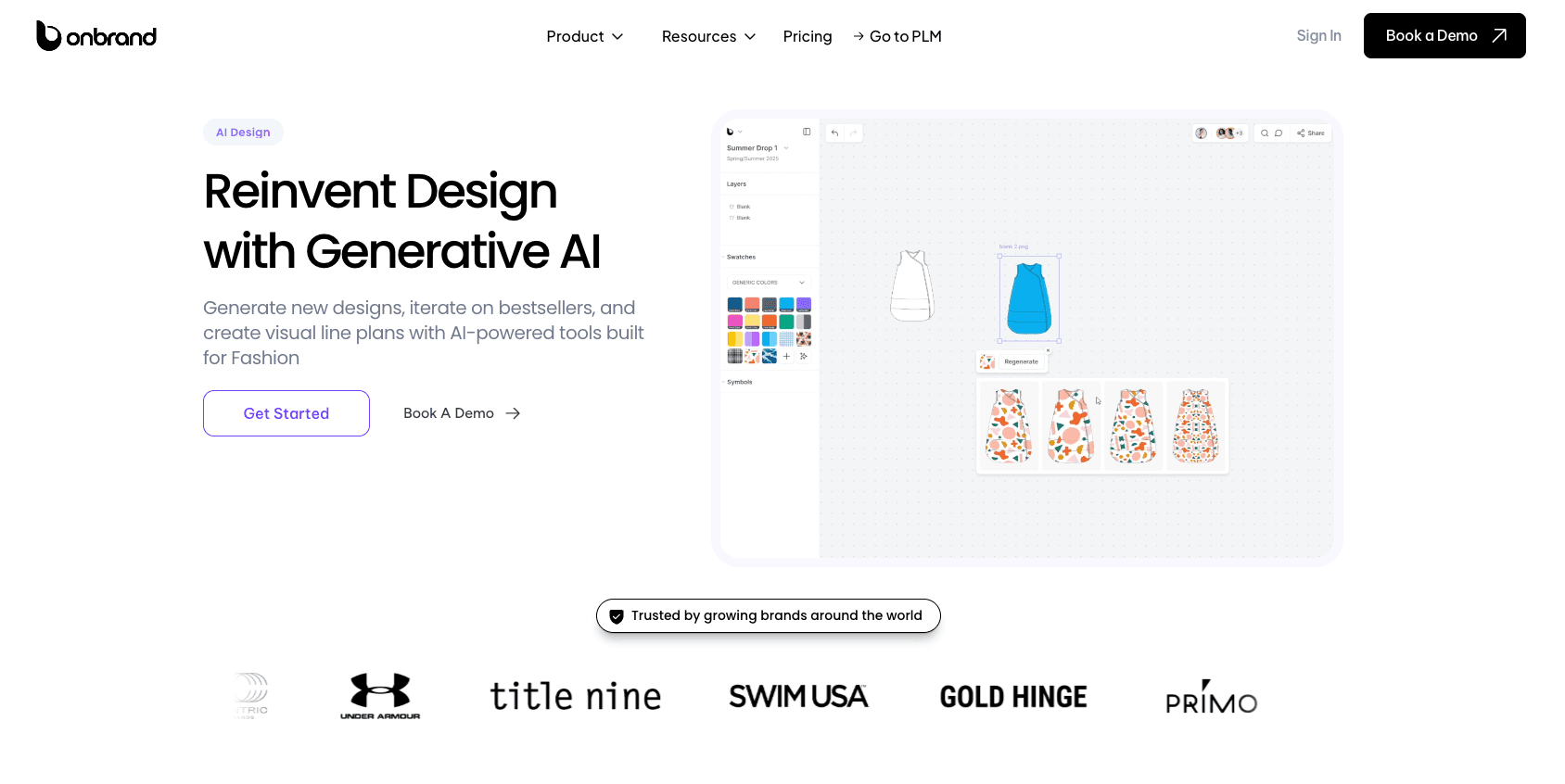
Approved concepts and assets can move directly into Onbrand PLM, where teams manage product information, materials, bill of materials (BOMs), tech packs, samples, collections, approvals, tasks, and supplier communication.
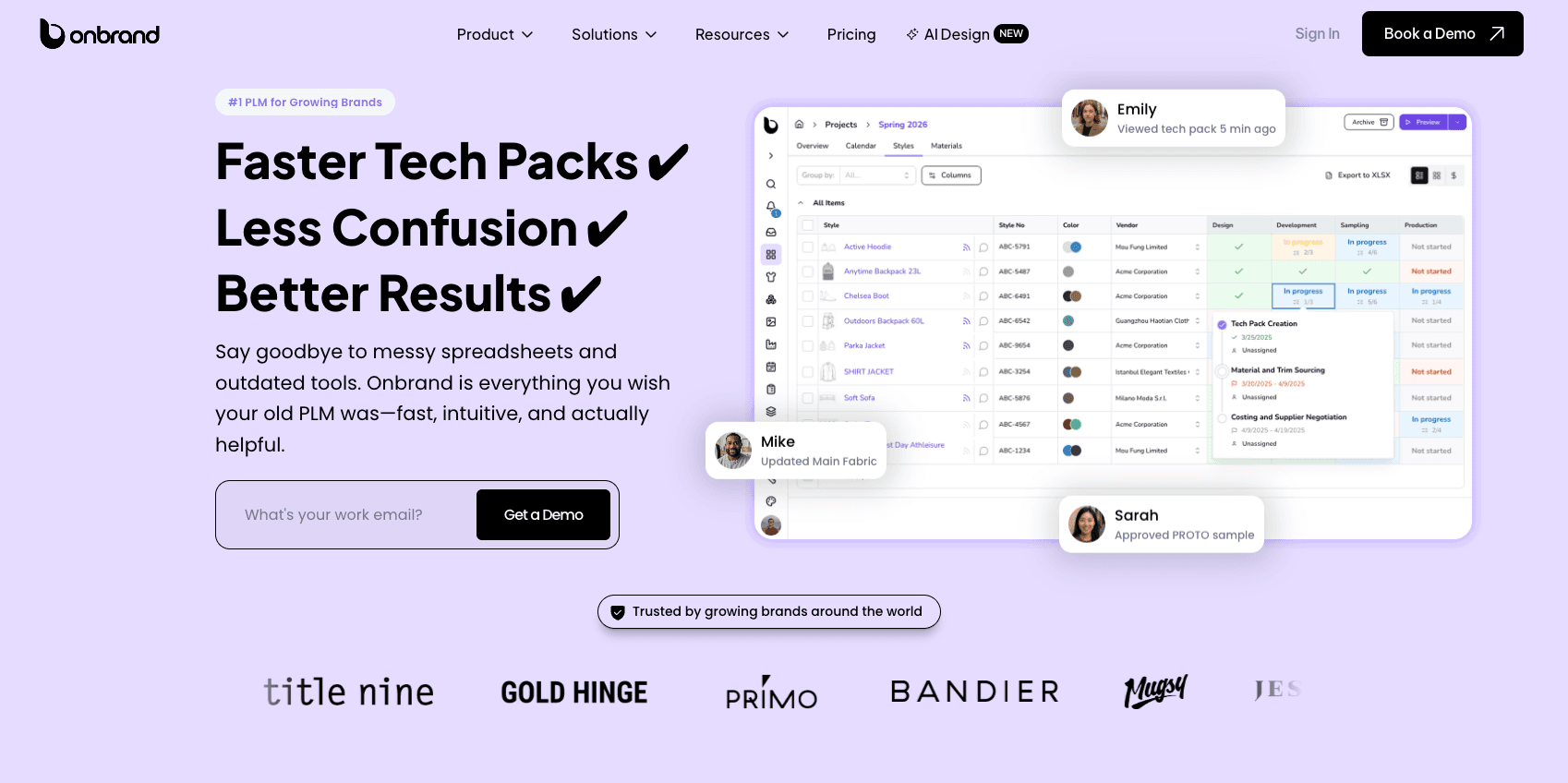
Teams using Onbrand can create tech packs 55% faster, cut four weeks from product development, and complete data migration and implementation in around 10 days.
Key Features
AI concept generation from text, sketches, and reference images
Colorways, design variations, photorealistic renders, and mood boards
Product information, materials, BOMs, and tech pack management
Samples, approvals, tasks, and supplier collaboration
Live web-based tech packs that keep factories working from current product information
Onbrand is purpose-built for fashion design and product development. Brands that also need accounting, POS, warehouse management, or full ERP functions can connect Onbrand with systems built for those operational needs.
2. Centric Software
Best For: Large fashion companies managing complex product development, sourcing, and planning at enterprise scale.
Source: centricsoftware.com
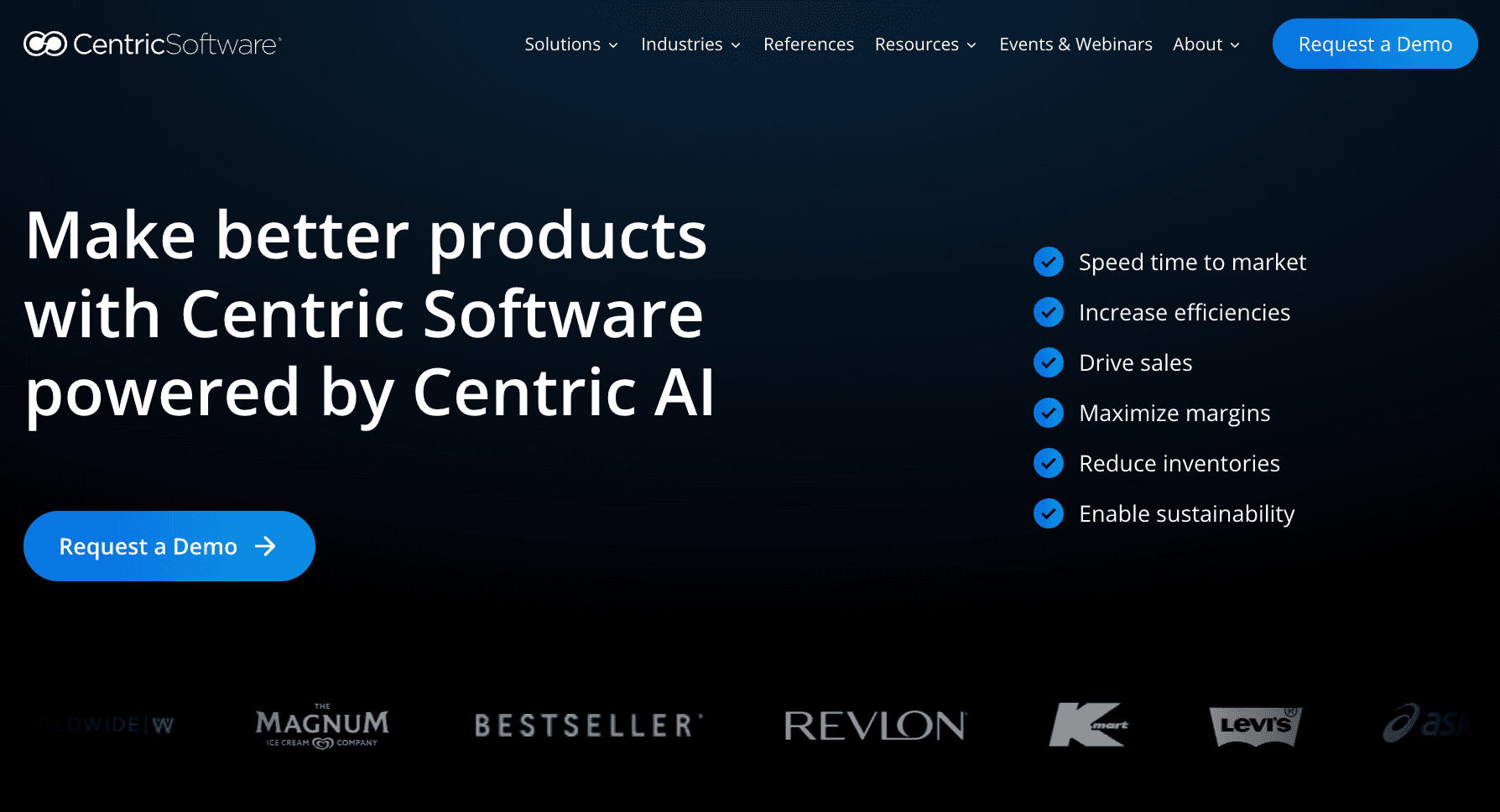
Centric Software offers a broader platform that includes Centric PLM, planning, pricing, and inventory, Market Intelligence for tracking competitors and market trends, visual boards, and PXM.
Centric PLM covers product development, materials, sourcing, costing, supplier collaboration, and related product data. Its wider product suite also supports planning and inventory decisions for seasonal collections and businesses operating through multiple markets.
Key Features
Product development and product data management
Materials, sourcing, costing, and supplier collaboration
Planning, pricing, and inventory tools
Market Intelligence for competitor and market trends
Support for leading fashion brands with complex global operations
The scope is geared toward organizations managing large product portfolios and multi-stage workflows. Teams considering Centric should look closely at which modules they actually need, along with implementation requirements, integrations, and the level of configuration involved.
3. WFX
Best For: Fashion brands and apparel manufacturers that need software for product development, sourcing, production, and related business operations.
Source: worldfashionexchange.com
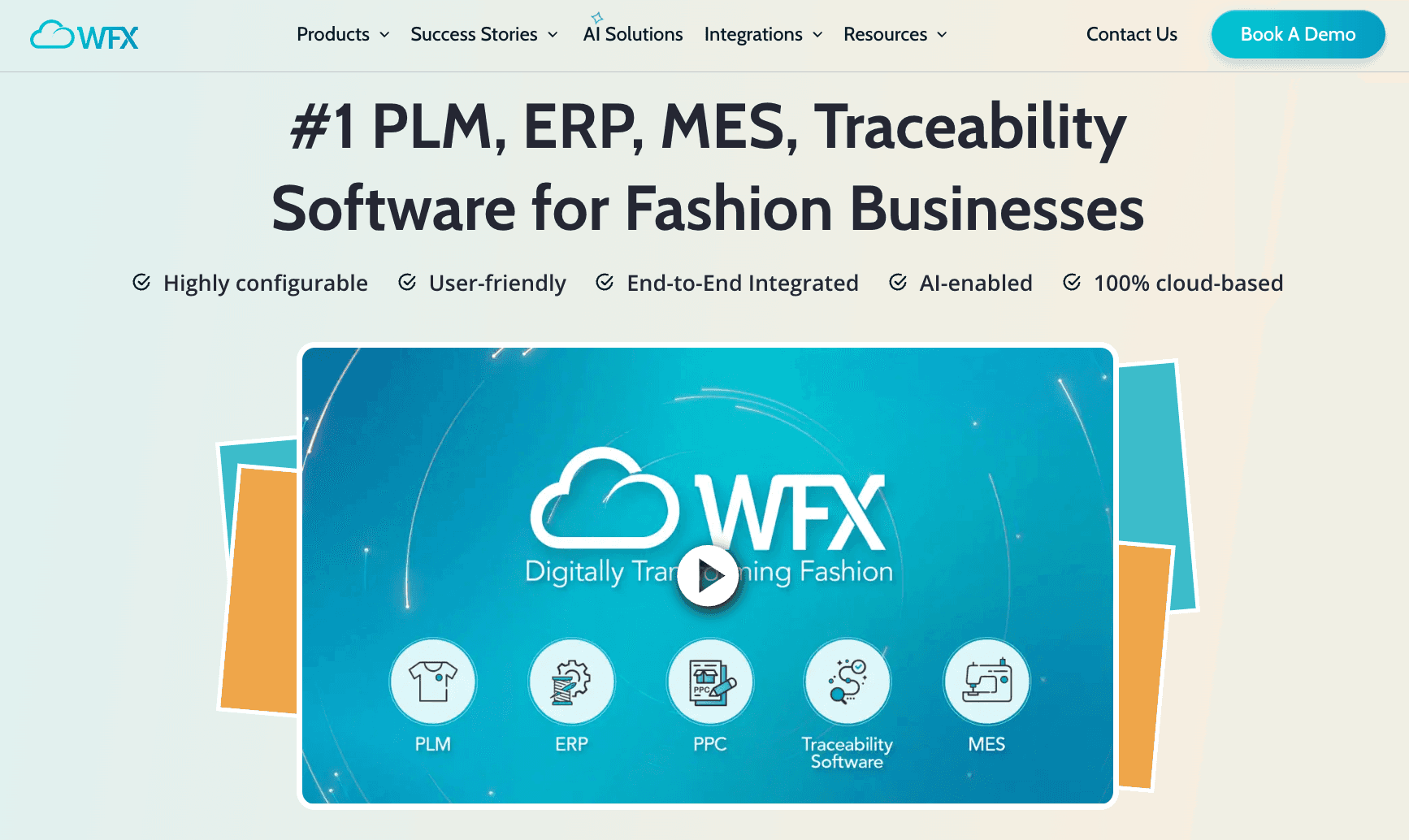
WFX offers cloud-based PLM, apparel ERP, textile ERP, MES, and traceability software for fashion and textile businesses. Its fashion PLM covers product data, design and development, sourcing, supplier communication, and related apparel-specific workflows.
For manufacturers, WFX also offers factory tools that extend into production, financials, and shop-floor management. Its vendor portal supports vendor management, while traceability tools are designed to map the supply chain and track materials and certifications.
Key Features
Fashion PLM for product development and product data
Apparel and textile ERP
Sourcing, supplier collaboration, and raw materials management
MES and shop-floor management
Traceability and vendor management for complex supply chains
WFX covers several areas of fashion operations, so its scope may be broader than needed for a team primarily looking for a focused design and product development system.
4. Uphance
Best For: Growing apparel businesses that need inventory, orders, production, and warehouse activity connected in one system.
Source: uphance.com
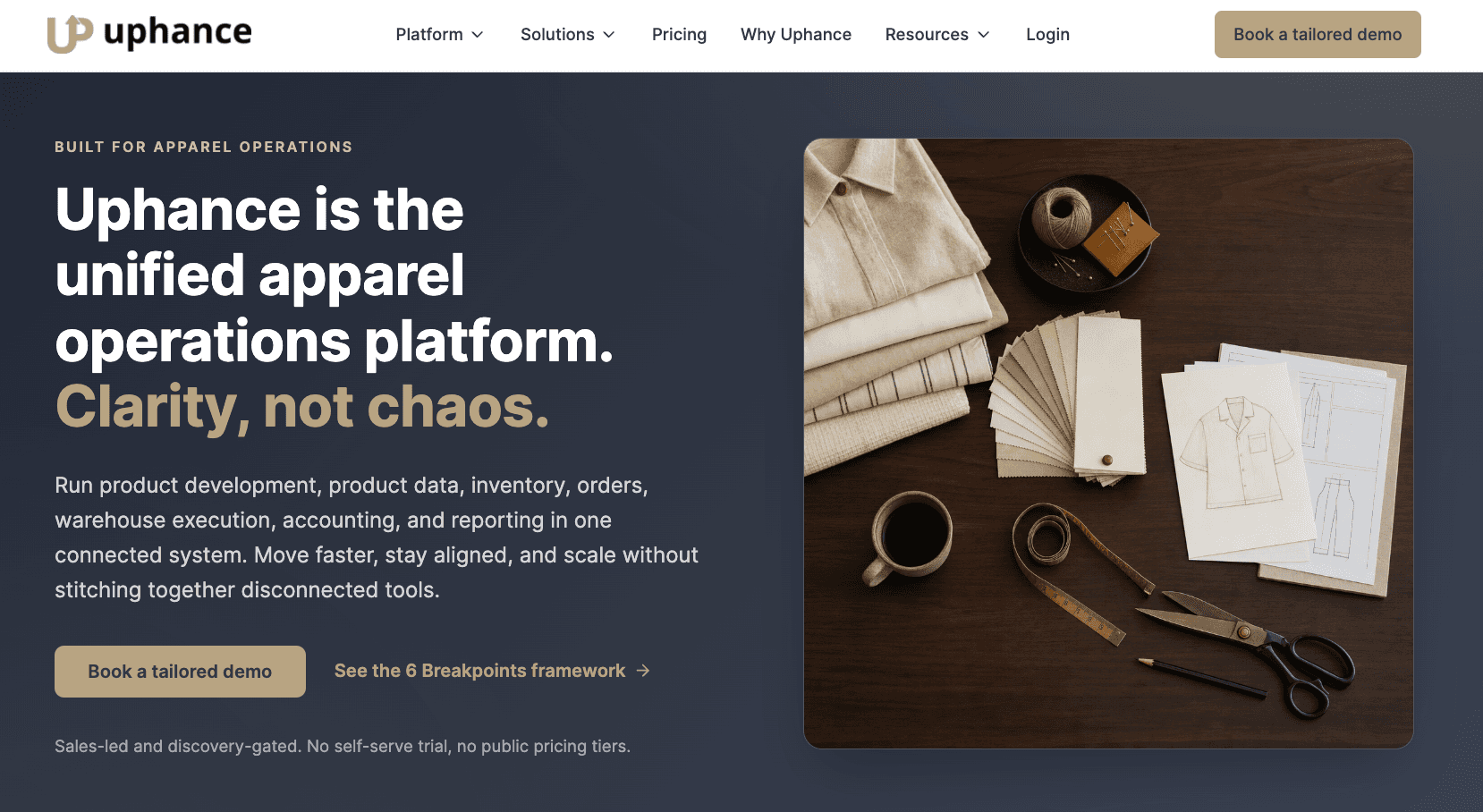
Uphance is an apparel operations platform that covers product data, production, inventory management, orders, warehouse execution, accounting, and reporting.
Its apparel inventory management software supports stock in multiple locations and sales channels, while its order management and warehouse management tools cover wholesale, DTC, receiving, picking, packing, and fulfillment.
Key Features
Real-time inventory tracking for multiple locations and sales channels
Product data and production management
Wholesale, DTC, and omnichannel sales
Order management, receiving, picking, packing, and fulfillment
Factory POs, accounting, and multiple warehouse setups
Uphance covers a broad operational scope, including PLM and production features. Teams mainly looking for deep creative design tools or a focused product-development PLM should compare how much of that broader operations functionality they actually need.
5. ApparelMagic
Best For: Apparel companies managing inventory, sales, purchasing, production, and related business operations.
Source: apparelmagic.com
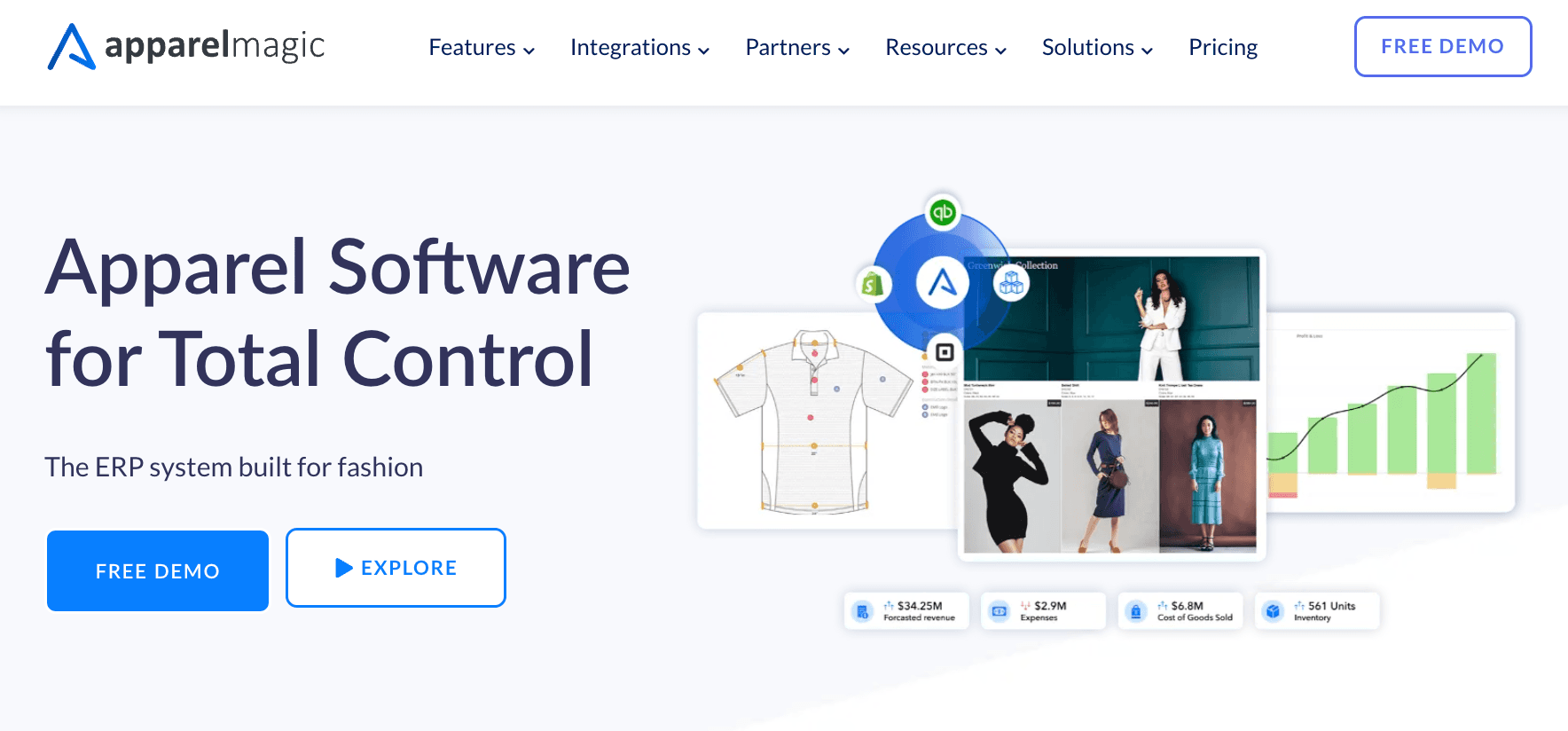
ApparelMagic is an apparel ERP solution that brings several core business functions into one system. Its tools cover inventory, sales and ordering, B2B e-commerce, manufacturing and production, logistics, fulfillment, and accounting.
The platform also supports purchasing and vendor workflows, financial reporting, and inventory valuation. ApparelMagic includes an integrated PLM module for product development and production-related records.
Key Features
Apparel ERP system for inventory, sales, and order management
Purchasing and vendor workflows
Manufacturing, production, logistics, and fulfillment
Accounting, financial reporting, and inventory valuation
Integrated PLM for product development and production records
Although ApparelMagic includes PLM functionality, teams primarily focused on detailed design development, tech packs, samples, and design approvals should compare its PLM capabilities with dedicated fashion PLM platforms to determine the right fit.
6. Bamboo Rose
Best For: Large fashion businesses and major retailers managing product development, sourcing, suppliers, and broader retail supply chain processes.
Source: bamboorose.com
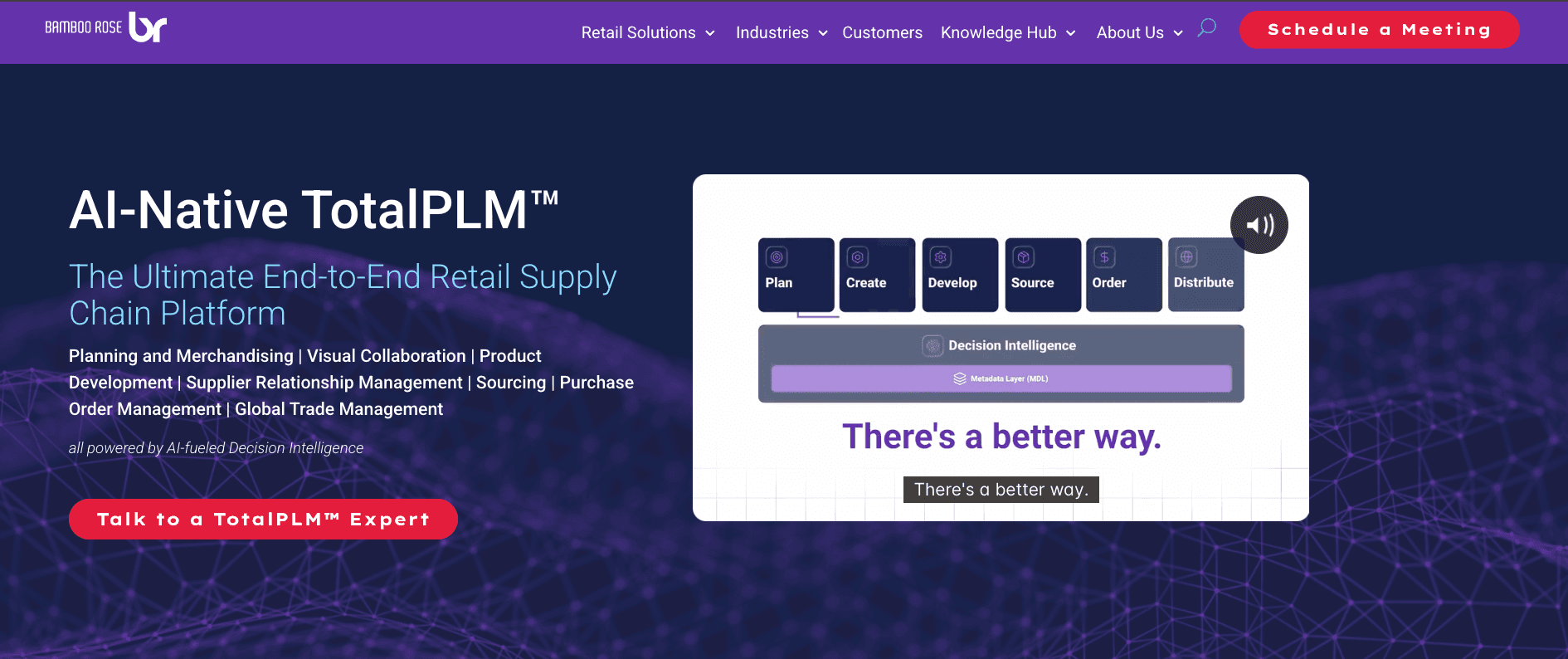
Bamboo Rose offers TotalPLM, a retail-focused platform covering planning and merchandising, product development, supplier relationship management, sourcing, purchase orders, and global trade management.
Its product development tools sit within a broader system that connects planning, design, sourcing, and trade.
Bamboo Rose also offers Decision Intelligence for predictive recommendations and data-driven decisions. Its planning tools use advanced analytics to work with demand signals, product performance, and other retail data.
Key Features
Planning and merchandising tools
Product development and supplier relationship management
Sourcing, purchase orders, and global trade management
Decision Intelligence for predictive recommendations
Advanced analytics using demand signals, product performance, and other retail data
Its broad retail scope and enterprise orientation may be more than smaller fashion teams need if they are primarily looking for a simpler product-development platform.
7. BlueCherry by CGS
Best For: Apparel brands and apparel wholesalers managing production, inventory, warehouse activity, and broader supply-chain operations.
Source: bluecherry.com
BlueCherry offers ERP, PLM, manufacturing, warehouse, planning, and wholesale tools for fashion, apparel, footwear, and other consumer goods businesses.
Its fashion ERP software covers business and supply-chain functions such as sourcing, inventory, warehouse management, e-commerce connections, and business intelligence for reporting and other operational analysis. Teams can also use sales data for sales trend analysis.
BlueCherry also offers MES and shop-floor tools for manufacturing, plus PLM for concept and product development.
Key Features
Fashion ERP software for sourcing and inventory management
Warehouse operations, e-commerce, and wholesale tools for multi-channel businesses
Business intelligence and sales trend analysis
MES and shop-floor tools for manufacturing
PLM for product development within complex operations
BlueCherry covers a wider operational scope than a design-first product development platform.
Teams mainly looking for concept creation, visual design exploration, and early-stage development should compare how much of its ERP, manufacturing, and supply-chain functionality they actually need.
How to Compare Apparel Cloud Software for Apparel-Specific Workflows
Choosing software starts with the work your team needs to manage. A long feature list is less useful if the platform does not support the products, processes, and systems already involved in that work.
Use the following criteria to narrow down the options.
Start With the Workflow You Need to Manage
Start with the problem that led to the software search.
A product team may be trying to replace manual processes around tech packs, samples, or approvals. An operations team may need better control over inventory, orders, production, or purchasing.
Write down the workflows that need improvement before comparing platforms. Your business needs might center on design and product development, sourcing, production, merchandising, or broader apparel management.
Consider how those needs may shift with new collections, sales channels, or emerging trends. Defining the work upfront makes it easier to compare systems based on what they actually need to support, not simply the length of their feature lists.
Check How It Handles Apparel Product Complexity
Apparel products rarely exist as single records. One style can have several colorways and sizes, creating multiple SKUs that still need to connect back to the same product, season, collection, materials, and BOM.
Generic inventory software may be able to track inventory, but that does not automatically mean it represents those apparel relationships well.
When reviewing the key features, test the system with a real product from your collection. Look at how it handles styles, variants, materials, seasons, and collections.
If inventory is part of the platform's job, also check how stock updates and variant-level records affect inventory accuracy.
Look at Supplier and External Collaboration
If suppliers or factories need access to the system, find out exactly what they can see and do.
Check how vendor management works in practice. Can a supplier access the latest product information without seeing unrelated records? Can factories comment on specifications, upload documents, respond to requests, and see approved changes?
Permissions deserve the same attention. Teams should be able to control access by user or role and understand how feedback and approvals are recorded.
Testing these workflows with a supplier scenario is more useful than simply seeing “collaboration” on a feature list.
Consider the Systems It Needs to Connect With
Few fashion businesses run every process in one platform. The software may need to exchange information with PLM, ERP, PIM, e-commerce, accounting, customer management, or 3D design systems already in use.
Map what information needs to move between them. Product details may need to reach sales channels, financial records may need to connect with financial management systems, and order or customer data may already live elsewhere.
Then check the available integrations, APIs, and data import or export options. The important question is not simply how many integrations are offered, but whether the platform can connect the systems your team actually uses.
Match the Platform to Your Team Size and Complexity
Company size alone does not determine how complicated a software setup needs to be. Mid-market brands can still manage hundreds of styles, several suppliers, multiple locations, or multi-entity operations.
Look at the number of users, collections, suppliers, warehouses, and business entities the platform needs to support. Apparel companies should also consider permissions, onboarding, migration, configuration, and the internal resources required to implement the system.
When comparing the best apparel ERP software or other apparel platforms, ask for transparent pricing around implementation, integrations, additional users, modules, and ongoing support.
That gives the team a better picture of the cost of supporting its actual level of complexity.
Look Beyond “Cloud-Based”
Cloud hosting alone says very little about how well software fits a fashion business.
Look for systems built for fashion or capable of handling the apparel processes your team actually uses. Industry-specific solutions should account for the product structures, users, integrations, and day-to-day work involved.
The same applies when comparing the best fashion ERP options. Test the system with real apparel products, review its collaboration and integration capabilities, and consider the effort required to implement it.
Those factors reveal far more about fit than the “cloud-based” label alone.
Onbrand Is Built for the Product Development Side of Apparel
Fashion product development moves through a series of connected decisions.
An early idea becomes a design, the design gains product details, and those details eventually need to guide sampling and supplier work.
Onbrand brings those stages into the same workflow. A team might begin in Onbrand AI Design to develop concepts and variations.
Once a direction is approved, the work can continue in Onbrand PLM as product information, materials, BOMs, and tech packs are developed.
From there, the product keeps moving without losing the decisions already made.
Sample feedback, supplier communication, revisions, and approvals stay connected to the product, so teams can follow its progress from the original concept toward a production-ready specification.
That connected workflow helps teams create tech packs 55% faster and cut four weeks from product development.
Onbrand focuses on the design and product development side of the apparel workflow.
Brands that also need accounting, warehouse management, POS, or other operational functions can use dedicated downstream systems alongside their PLM.
Keep Apparel Product Development Connected With Onbrand

The best apparel cloud software depends on the part of the business your team needs to manage. Inventory, production, and ERP systems solve different operational needs. Product development requires a platform built around the work that happens before production.
For that stage, Onbrand gives fashion teams a dedicated place to move from early design through production preparation. It keeps creative and technical product development in the same system as a collection moves forward.
If product development is a priority for your team, Onbrand is built specifically for that work.
Ready to see how it could fit your team? Book a demo and explore Onbrand for your next collection.
FAQs About Apparel Cloud Software
What is the best software for apparel design?
The best software for apparel design depends on how far the team needs to take its ideas. Onbrand is a good option for fashion teams that want to create concepts and variations with AI Design, then move approved designs into PLM for product development, tech packs, materials, samples, and approvals.
What is the best software for apparel production?
The best software for apparel production depends on the type of production work the business needs to manage. WFX and BlueCherry are two options with manufacturing tools for apparel businesses, including production management and shop-floor capabilities.
What are the top three ERP systems?
For fashion and apparel businesses, WFX, ApparelMagic, and BlueCherry are three ERP systems worth considering. Their capabilities vary, but they can support inventory, purchasing, orders, production, financial management, and supply chain operations.
What is the best software for a clothing store?
Uphance and ApparelMagic are two options for clothing businesses that need to manage inventory, orders, sales, and fulfillment. When choosing software, consider real-time inventory visibility, order and warehouse management, and automated replenishment if those capabilities are important to the business. Accurate stock and order information can also support a better customer experience.
Why would a fashion business use apparel ERP software?
With apparel ERP software explained in practical terms, its value comes from bringing operational information into the same system. Inventory, purchasing, orders, production, and financial records can be easier to manage together as the business grows. That visibility can support faster decisions and give the business a competitive advantage when managing day-to-day operations.
ApparelMagic® is a registered trademark. ApparelMagic is not affiliated with or endorsing Onbrand.